Why Your Next Motorcycle Helmet Needs MIPS Technology
When shopping for a motorcycle helmet, most riders look at safety certifications like DOT or ECE 22.06, comfort, ventilation, and graphics. However, an essential safety innovation in recent years focuses on a threat standard tests historically overlooked: rotational motion. That technology is MIPS (Multi-directional Impact Protection System).
Linear vs. Rotational Impacts: What is the Difference?
Traditional motorcycle helmets are engineered primarily for linear impacts—a straight-on blow perpendicular to an obstacle. Inside a standard helmet, the expanded polystyrene (EPS) foam liner crushes to absorb this direct energy.
Real-world motorcycle crashes rarely happen in straight lines. Most impacts occur at an angle when a rider strikes the tarmac or an obstacle while moving forward.
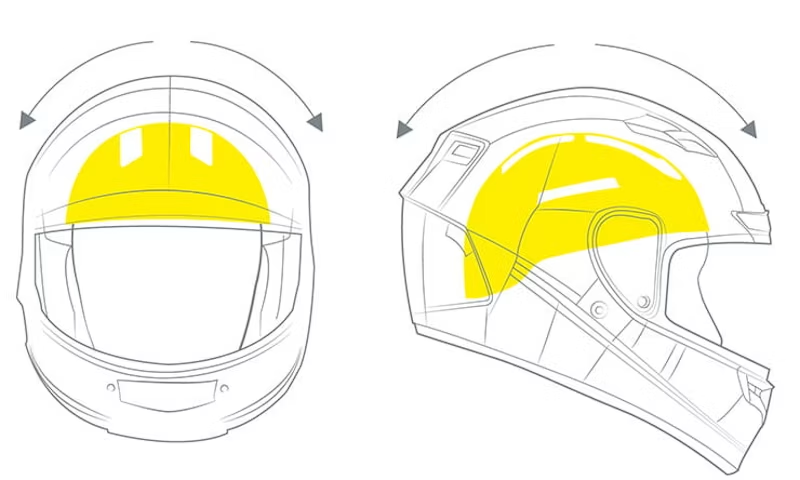
An angled impact creates rotational motion—a rapid combination of rotational energy and angular acceleration. This sudden twist transfers directly to the head, causing the brain to slide and stretch against the inside of the skull, which significantly increases the risk of concussions, subdural hematomas, and severe traumatic brain injuries (TBIs).
How MIPS Protects Your Brain
MIPS mimics your body’s natural defense mechanism. The human brain is surrounded by cerebrospinal fluid, which allows the brain to shift slightly within the skull during a shock.
- The Low-Friction Layer: Inside a MIPS-equipped helmet, a thin, low-friction layer sits between the comfort padding and the EPS foam liner.
- Controlled Movement: During an angled impact, this layer allows the helmet shell to slide relative to your head by 10 to 15 millimeters in any direction.
- Energy Redirection: Those few millimeters of movement during the critical first 5 to 10 milliseconds of an impact redirect the damaging rotational forces away from your brain tissue.
Is MIPS Worth the Upgrade?
- Subtle Integration: Modern MIPS systems are engineered not to compromise airflow, interior comfort, or fit.
- Minimal Weight Penalty: The low-friction layer adds only a negligible amount of weight (typically between 25 and 45 grams).
- Proven Laboratory Testing: Independent biomechanical studies demonstrate a noticeable reduction in strain levels transmitted to the brain during oblique collisions compared to standard EPS-only helmets.
Investing in a helmet equipped with a rotational management system provides an extra layer of protection where traditional safety standards leave a gap. When planning your next ride or track day, prioritizing rotational impact protection is one of the smartest upgrades you can make.
One response to “MIPS Technology”
Hi, this is a comment.
To get started with moderating, editing, and deleting comments, please visit the Comments screen in the dashboard.
Commenter avatars come from Gravatar.