The Lifesaving Tech Under Your Jacket: Are Motorcycle Airbag Vests Worth It?
For decades, protective motorcycle gear meant abrasion-resistant leather, cordura textiles, and CE-rated armor pads over joints. While armor mitigates road rash and localized fractures, blunt-force trauma to the chest, ribs, spine, and internal organs remains a major risk during high-speed crashes. Enter the motorcycle airbag vest—the most significant leap forward in rider safety since the full-face helmet.
How Motorcycle Airbag Vests Work
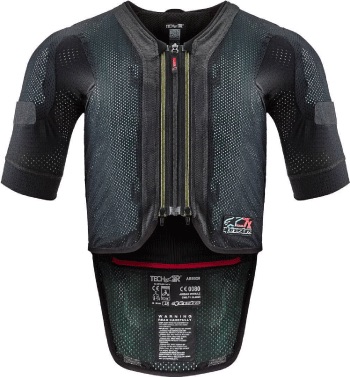
An airbag vest sits either over or beneath your riding jacket. Within milliseconds of detecting a crash, cold gas canisters deploy cushions of air around critical anatomical zones:
- Spine and Neck: The inflated cushions stabilize the cervical spine and prevent severe hyperextension or whip-motion.
- Thorax and Ribcage: The air chambers absorb blunt impacts from handlebars, curbs, or other vehicles, dramatically lowering the risk of punctured lungs and broken ribs.
- Collarbone Support: Many modern vests expand around the shoulders to distribute force away from fragile clavicle bones.
Mechanical vs. Electronic Systems: Which Is Better?
There are two primary categories of motorcycle airbags on the market today:
- Tethered (Mechanical) Systems:These vests connect directly to the motorcycle frame using an elastic cord. When the rider is separated from the bike in a high-side or ejection, the tether pulls a mechanical trigger, puncturing a $CO_2$ cartridge to inflate the vest instantly (typically within 100 to 200 milliseconds). They require no battery charging and are simple to reset, but won’t trigger if you are struck while stationary at a traffic light.
- Autonomous (Electronic) Systems:Equipped with high-frequency gyroscopes, accelerometers, and integrated GPS, these vests use predictive algorithms running hundreds of calculations per second. If the internal unit senses sudden deceleration, loss of traction, or a collision from behind, it inflates in as little as 25 to 40 milliseconds—long before the rider makes physical contact with an obstacle.
Key Takeaway for Modern Riders
While an airbag vest represents an upfront investment, the level of energy absorption it offers vastly exceeds standard CE Level 2 foam back protectors. Whether you commute in heavy urban traffic, tour on weekends, or push lap times on track days, adding an airbag layer is the closest thing to surrounding yourself with an invisible crumple zone on two wheels.